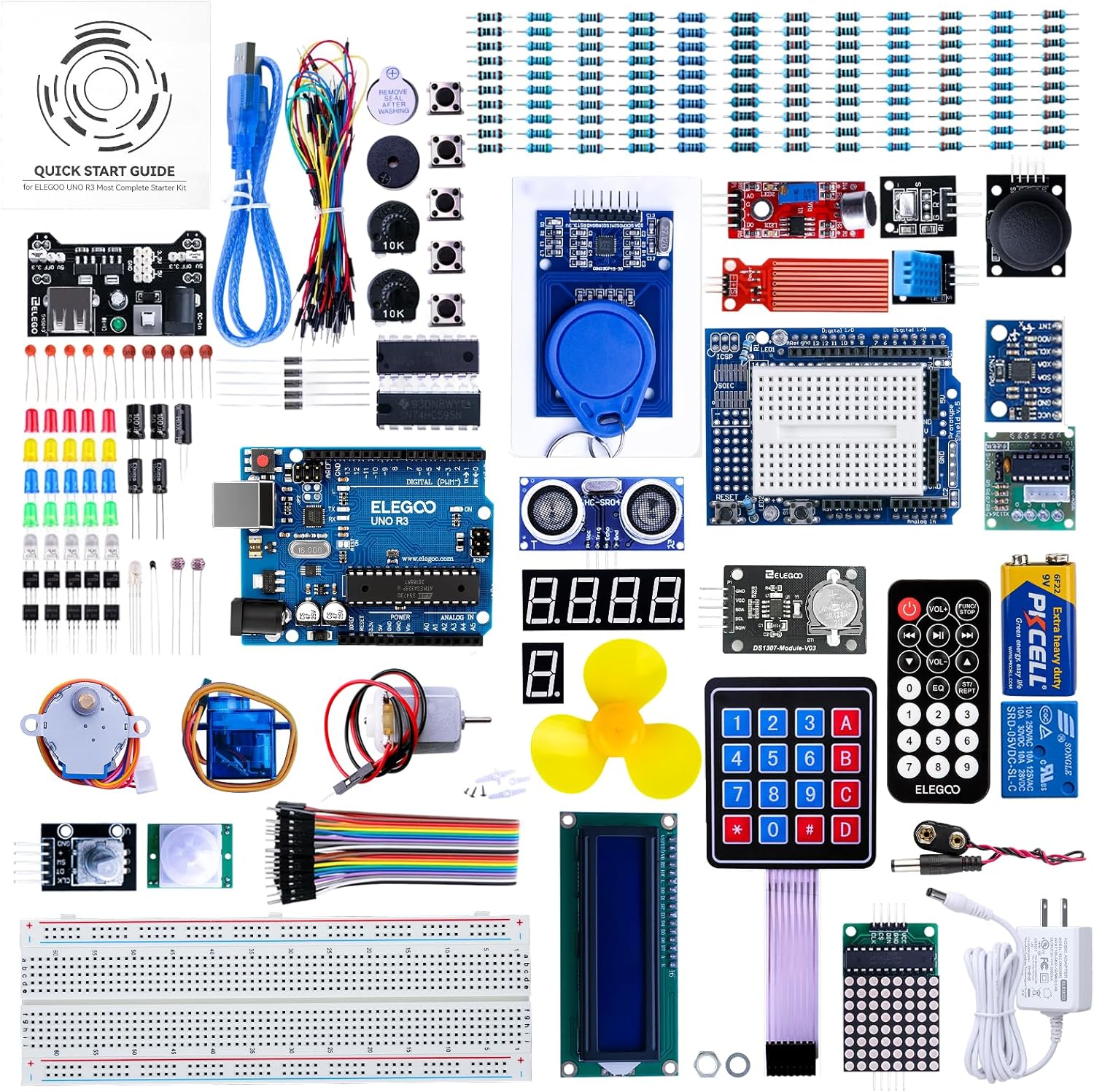
Note, that the instructor and student has the choice to use any type of microcontroller (MCU). In reality, every project detailed in this book can be done with an Arduino with the notable exception being Method 3 Data Acquisition lab. In that lab, data is stored on the MCU itself since the CPX has built-in storage. However, Arduino does not have built-in storage which is one of the limitations with Arduino. However, it the experience of the primary author teaching this course that many groups choose to use an Arduino UNO/Mega/Nano or ESP32 for their final project. This is because although the CPX/CPB is a cheap MCU that has many built-in sensors, it is severely lacking in stability, memory and power capabilities. Using an Arduino will allow a larger world of possibilities and thankfully CPX/CPB programming/hardware skills will transfer very easily to Arduino. As such, many labs will have an Arduino alternative in the event students have found the Arduino to be more useful for that specific lab. So the question of course is why isn’t the entire class just built around Arduino? The answer is because for $20 the CPX/CPB comes with two push buttons, a slide switch, an accelerometer, a temperature sensor, 8 neopixels, a light sensor, a microphone, a speaker and a much simpler programming language. The CPX also has an IR sensor and the CPB supports bluetooth communication. The Arduino does not have any of those extra capabilities. This means in order to perform many of the experiments in this book, the students will need to buy extra supplies if you use an Arduino. For example, in order to store data on a standalone project using an Arduino requires the use of an extra micro SD card breakout board and a micro SD card. Furthermore, for the accelerometer lab, the students would need to purchase an extra external accelerometer. In this case, at the time of this writing, that represents an extra $10 on top of the microcontroller itself which is $27.60 on the Official Arduino Store. The bottom line is that the authors feel that students get more out of learning on a CPX/CPB given the seamless integration of sensors and the much easier programming language. Once they gain mastery over the CPX/CPB they can then take those skills to something more reliable like the Arduino MCU or even something more complex like a Raspberry Pi. Still, in the event the student would like to purchase an Arduino instead of the CPX/CPB, the recommended Arduino is the Arduino UNO R3 which can be purchased on the official Arduino store [35]. The UNO is a great starting point for learning about microcontrollers and has a large online community for support. However, if you want to do more complex projects in the future, you may want to consider purchasing an Arduino Mega or an ESP32 which have more memory and capabilities than the UNO. However, instead of purchasing just the Arduino it’s recommended to buy a kit that comes with a lot of extra components. For example, the Elegoo UNO R3 Kit[67] comes with a lot of extra components that will allow you to do many of the projects in this book without having to purchase extra components. At the time of this writing the kit is $47.99 and all the components is shown below.